


Your shopping cart is empty!
Radish "Lada"

Eco seeds

Radish "Lada".
All-season variety: from early spring to late autumn!
A mid-early, high-yielding variety (33-37 days) for all-season cultivation. Resistant to bolting and stalk formation.
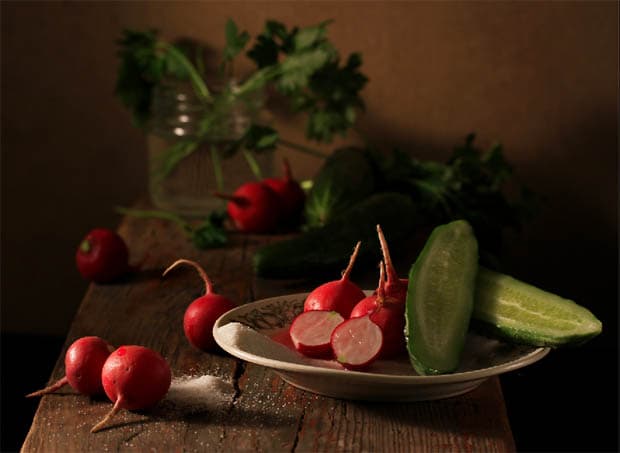
Roots are large with white, tender flesh. They do not become pithy (overgrown) for a long time, have a beautiful round shape, bright red colour, and lack an unpleasant sharp taste.
The variety is universal: suitable for growing in greenhouses and in open ground to obtain spring, summer, and autumn harvests.
1.0 g = 70-130 seeds.
All-season variety: from early spring to late autumn!
A mid-early, high-yielding variety (33-37 days) for all-season cultivation. Resistant to bolting and stalk formation.
Roots are large with white, tender flesh. They do not become pithy (overgrown) for a long time, have a beautiful round shape, bright red colour, and lack an unpleasant sharp taste.
The variety is universal: suitable for growing in greenhouses and in open ground to obtain spring, summer, and autumn harvests.
1.0 g = 70-130 seeds.
* Growing radishes in open ground: tips and tricks.
For sowing radishes, choose areas that emerge early from under the snow, protected from cold winds, with light, very fertile soil.
The best predecessors are potatoes, tomatoes, cucumbers, onions, and beans.
It is not recommended to sow radishes after cabbage, turnips, and radishes, as they are affected by the same diseases and pests.
Root crops grow well on soils with different acidity (pH 5.5-7.3), so liming is carried out only on very acidic soils.
Organic fertilizers (4-5 kg/m²) are applied under the preceding crop. If this was not possible, then in autumn, rotted manure or humus (3-4 kg/m²) is applied - on fertile soils, radishes can be grown without organic fertilizers.
In autumn, 6-9 g/m² of phosphorus (13-20 g of double superphosphate) and 10-12 g/m² of potassium (16-20 g of potassium chloride) are applied. Nitrogen fertilizers (12-18 g of ammonium nitrate) are applied at a dose of 4-6 g/m² when levelling the soil in spring.
Attention! Radish is prone to increased accumulation of nitrates, so nitrogen doses should not exceed 6 g per 1 m².
Do not apply fresh manure before sowing radishes, as this will lead to strong growth of leaves at the expense of root crops.
The place for sowing early radishes is chosen to be open and sunny, and for June or July sowing, when the days are long, it is better to sow radishes in slightly shaded places.
Radish loves fertile, well-drained soils.
The plot is dug up in autumn. Before sowing, 5-6 buckets of compost per 1 m² and complete mineral fertilizer are applied. To disinfect the soil, increase phosphorus, potassium, and other microelements in it, as well as to accelerate snow melting, ash mixed with potassium permanganate (1 bucket of ash + 5 g of potassium permanganate per 20 m²) is scattered on the surface in March. This will accelerate snow melting by more than a week.
A bed for radishes in open ground is made in early spring. The soil is watered with hot (+50°C) water and dug to the depth of a bayonet shovel. Then 2-3 kg of humus or compost and peat are added. From mineral fertilizers, a tablespoon of nitrophoska or other complete fertilizer is added. After applying nutrients, the bed is dug with a pitchfork to a depth of 10-12 cm, levelled, and slightly compacted.
Important: Wood ash and potash fertilizers are not applied directly before sowing radishes to avoid bolting.
The width of the bed is made up to 1.5 m, the length — no more than 15 m. Beds can be paired, but then a distance of 50 cm must be left between them. Beds should be located taking into account the prevailing wind direction.
Furrows are made at a distance of 10-12 cm from each other, 2-2.5 cm deep, watered with warm (+30+35°C) water, and sowing begins.
Radish belongs to short-day plants, so it is sown early — from April 16 to 18 and from April 26 to 28, as well as from May 10 to 12 and from May 22 to 25. Late varieties of radish (for winter storage) are sown from August 1 to 10.
In early spring, radishes are sown on plots intended for planting late cabbage, or as a compactor for cabbage and cucumbers. Later, areas freed from early potatoes are occupied by it. Therefore, it is not necessary to specially prepare beds for radishes.
Radish is sown as soon as the soil condition allows cultivation (i.e., when the soil thaws to a depth of 3-4 cm). Under conditions of the middle zone, this happens approximately on April 15-20. Seeds are sown by nesting or row method at a distance of 5 cm. Radish seeds will germinate faster if the earth is mulched with peat and humus.
Radishes are sown with an interval of 10-12 days. The most accurate indicator for subsequent sowing is the appearance of the first true leaf in plants of the previous sowing. Furrows are made on the beds at a distance of 10-15 cm. Seeds are placed at a distance of 3-4 cm from each other. Embedded to a depth of 1.5-2 cm. Seeding rate 1.5-2 g per 1 m².
For autumn use, radishes are sown no later than late July - early August. The seeding rate is reduced to 0.8 g per 1 m², sown more sparsely (distance in rows 5-6 cm). However, keep in mind that pre-winter sowing often leads to bolting of plants.
Care, watering, and feeding.
Radish is a moisture-loving crop. Unlike other vegetable crops, it has a shallow root system, so it needs a sufficient amount of moisture throughout the growing season. With its lack, root crops lengthen, become flabby, and have an unpleasant taste.
This culture is also demanding of lighting. If the tops grow in the shade, the root crop will be of poor quality. Radish forms the best root crop with a 10-12 hour day. If the daylight hours are longer, the root crop develops faster, which, alas, contributes to bolting (by the way, the same happens in dry and hot weather).
Crops are watered evenly every 2-3 days, in dry weather — daily (at night). In the first 10 days after germination, it is enough to wet the earth by 8 cm, and with the beginning of root formation — not less than 15 cm.
In the summer months, plants are watered in the morning and evening, in small doses (2-3 l/m²). During root filling, watering is reduced to moderate, otherwise only tops will grow.
If a crust has formed after watering, the soil must be loosened or covered with a layer (1-2 cm) of humus. Systematically weed. With slow growth and light colour of leaves, plants need to be fed with a garden mixture (40 g per 10 l of water). Feeding with fermented herb infusion is also considered good.
You can also make such a top dressing: dilute a teaspoon of urea or kristallin in 10 litres of water, stir the solution, and water the bed at the rate of 3-4 litres per 1 m².
Beds are kept under film until the plants have leaves 6-8 cm high. Then the film can be removed.
Radish shoots appear quickly. 5-6 days after emergence, they are thinned out, removing weak and deformed plants, leaving only beautiful ones at a distance of 4-5 cm from each other. Then the radish is watered from a small watering can by sprinkling at the rate of 2 litres per m². After some time, when the bed has weathered, a small loosening is done between the rows and the plants are earthed up to the cotyledon leaves.
To combat cruciferous flea beetles, before loosening, as well as before earthing up, dry mustard or ground black and red pepper are scattered in the row spacing (at the rate of: a teaspoon per 1 m²).
Dusting seedlings with tobacco dust mixed with lime or ash (1:1) helps against cruciferous flea beetles.
Remembering the useful neighbourhood of spinach (its seedlings are not damaged by pests), you can sow 1-2 rows of spinach on a bed with radishes.
Thus, care for radishes consists of watering, timely weeding, thinning (by 5-6 cm), loosening after each watering and rain, feeding, and fighting flea beetles (repeated dusting with wood ash or dust).
Harvesting and storage.
Depending on the variety, the radish harvest is ready on the 25-45th day after sowing. At the same time, ripe radish in the garden retains high quality of root crops only for a few days. As soon as the root crops are ready for harvesting, they must be immediately collected, washed, put in a plastic bag, and put in the refrigerator. If the radish is left in the garden, it will quickly lose quality — the root crops will become coarse, and the plant will go to seed.
First, harvesting is carried out selectively as the root crops ripen, and only then — completely.
Ripe root crops are dug up, freed from tops, and put in plastic bags (no more than 2 kg).
Attention! Roots of radishes do not need to be cut, and tops are cut 1.5-2 cm from the root crop.
Radish can be stored in another way. Harvested radishes with tops are tied in bunches, tops are slightly moistened, put in plastic bags of 1-3 kg, tied tightly, and put for storage in a refrigerator or in a cool place with a temperature of +2+3°C.
A repeated harvest of high-quality radishes can be obtained in the second half of October. To do this, sow in early August. Autumn radish harvest is stored in dry sand at 0+1°C.